The Mantis Method: The 3-Discipline System for Consistent Deal Flow

Tools find leads. The Mantis Method turns leads into deals.
Most real estate investors don't have a lead problem. They have a conversion problem.
They buy lists. They drive for dollars. They pay for skip tracing. And then... nothing. The leads sit in a spreadsheet. The follow-up gets inconsistent. The offers never go out. Six months later, they're buying another course wondering why this isn't working.
The problem isn't the leads. The problem is the system, or the lack of one.
The Mantis Method is a 3-discipline operating system designed to fix that. It's not a new investing strategy. It's not a secret hack. It's a structured approach to the three things that actually determine whether you close deals: consistent pipeline activity, disciplined follow-up, and systematic offer-making.
Why "The Mantis Method"?
The praying mantis is patient. Precise. Efficient. It doesn't chase. It positions itself, reads the signals, and strikes at exactly the right moment.
That's what consistent deal flow looks like. You're not running around chasing every lead. You're building a system that positions you in front of motivated sellers, reads the distress signals, and makes the right move at the right time.
The Mantis Method has three disciplines:
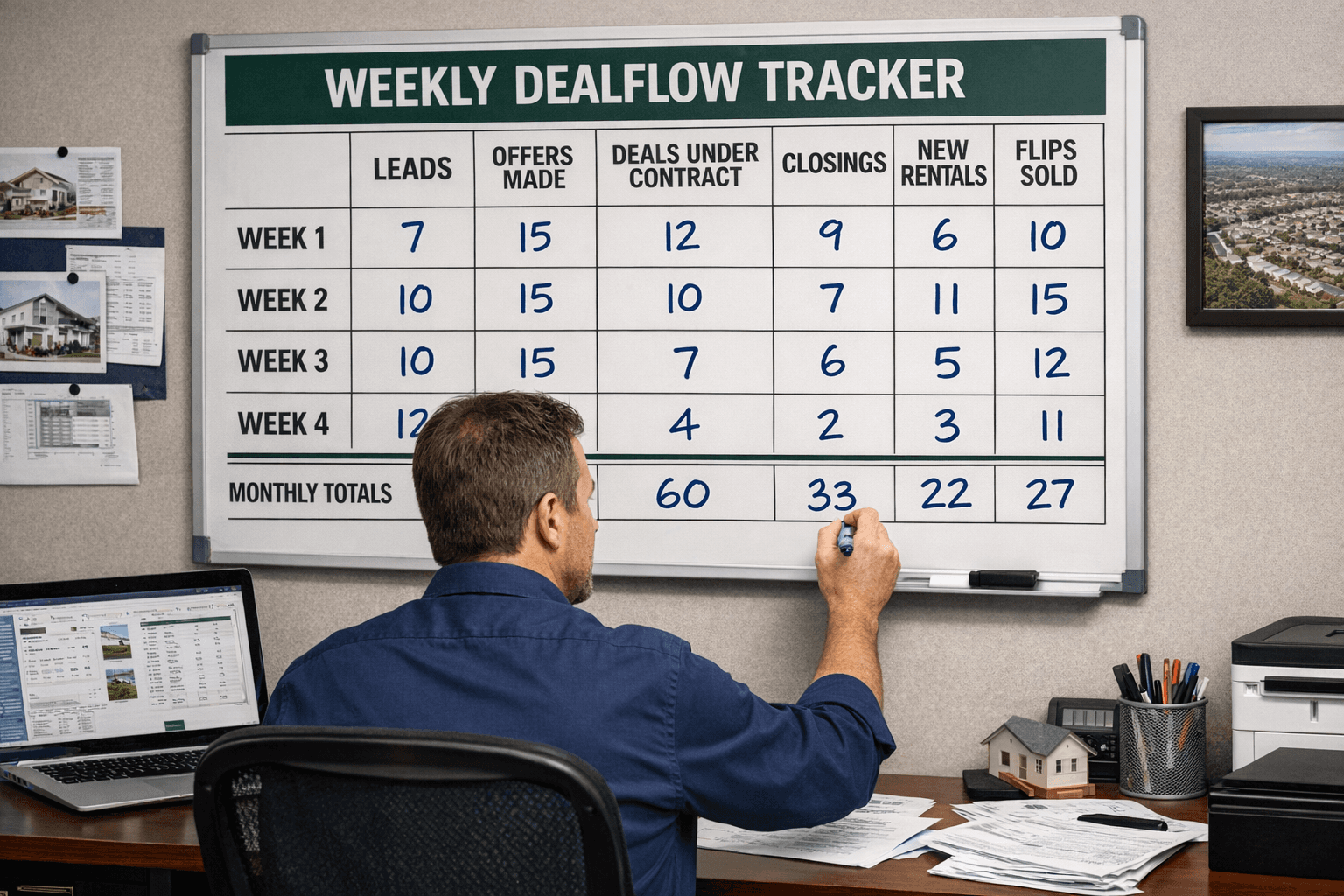
- Mantis Dealflow Discipline - The weekly scoreboard that forces consistent pipeline activity
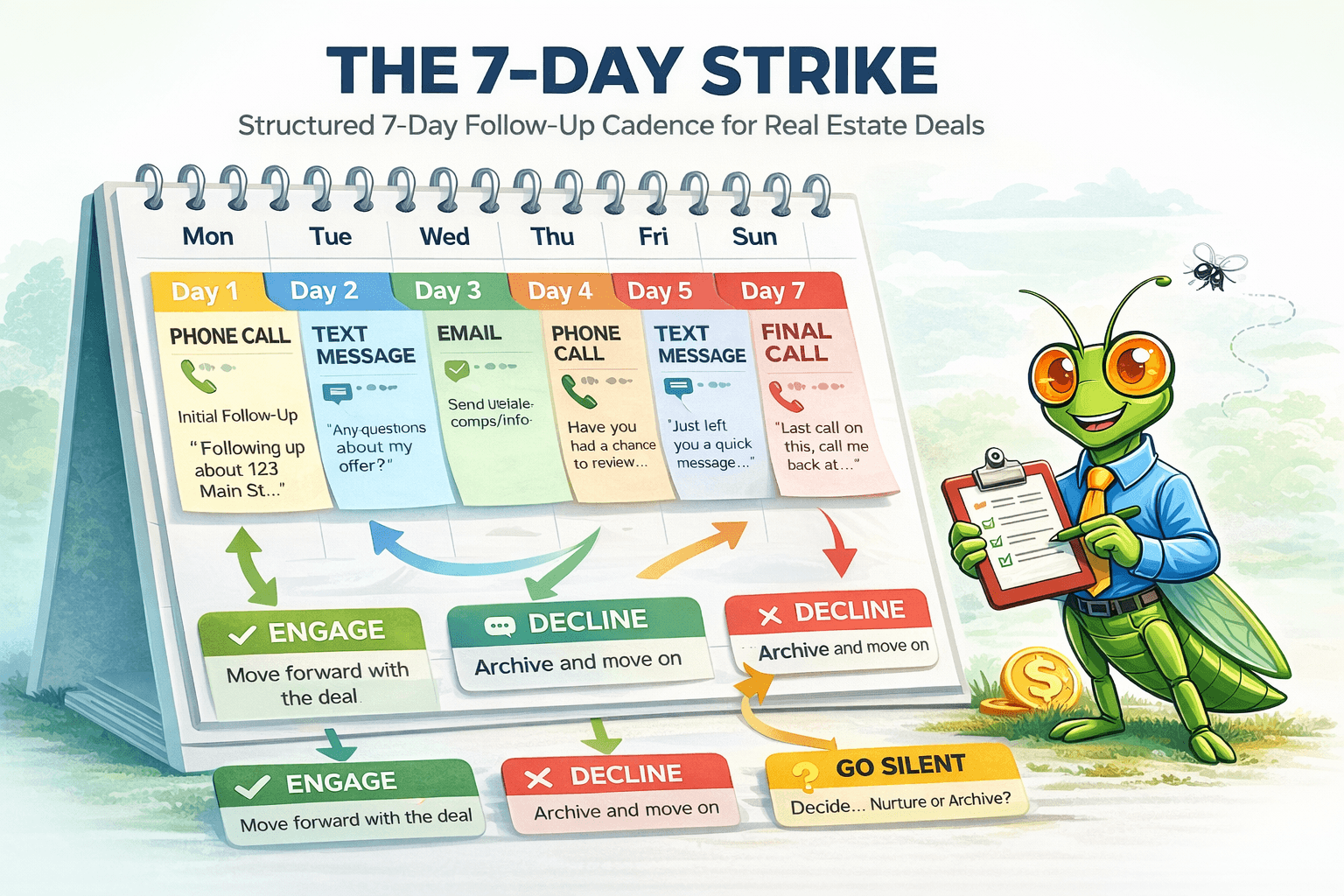
- Mantis 7-Day Strike - The follow-up cadence that converts leads before they go cold
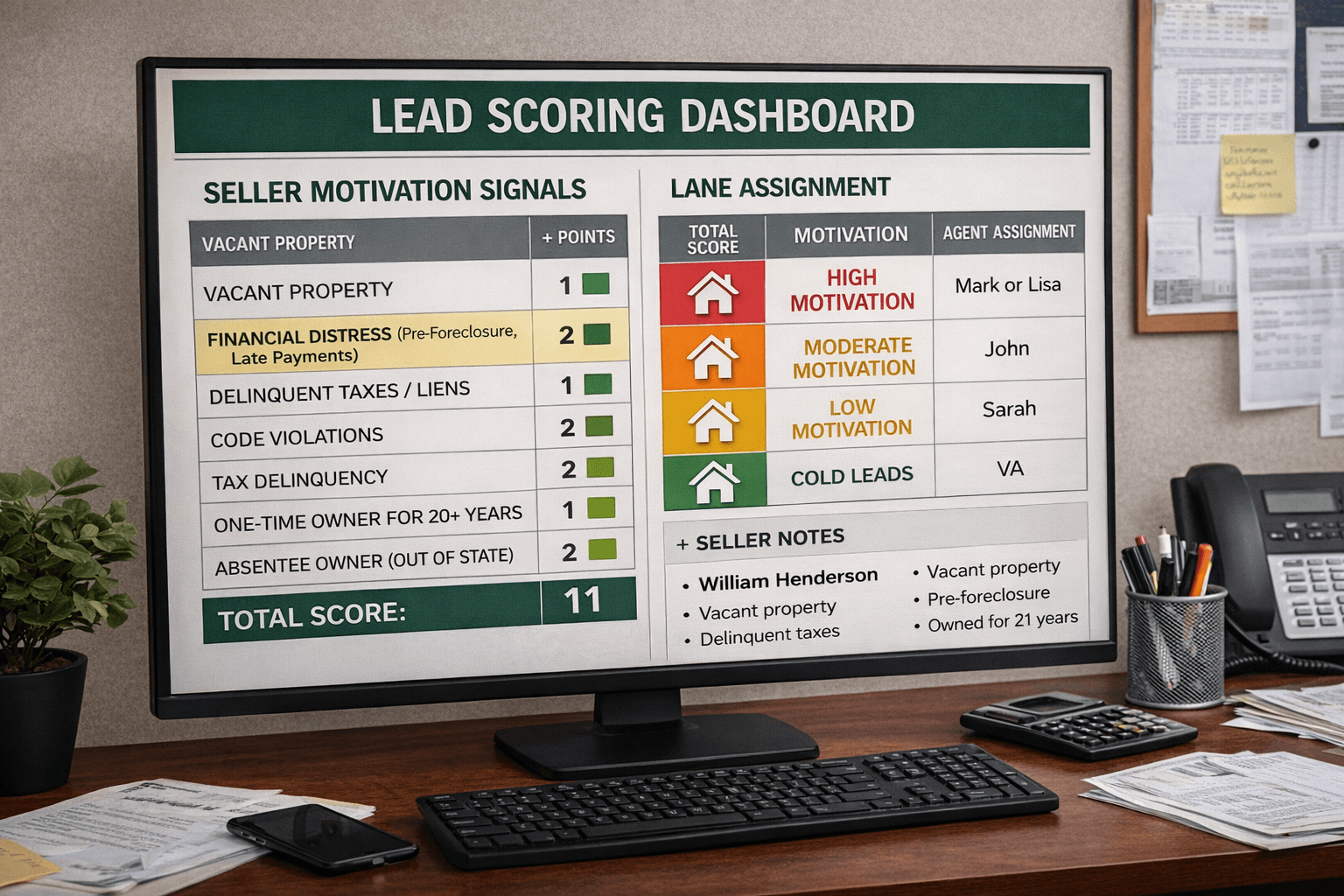
- Mantis Signal Sensei - The scoring system that reads distress signals and guides your offers
Each discipline solves a specific failure point. Together, they create a repeatable machine for finding, contacting, and converting motivated sellers.
Discipline 1: Mantis Dealflow Discipline
The Problem: Most investors work in bursts. They generate leads for a week, get busy with a deal, stop marketing, close the deal, and then panic because the pipeline is empty. This feast-or-famine cycle kills momentum and income predictability.
The Solution: A weekly scoreboard with three non-negotiable numbers.
The 20-5-1 Rule
Every week, you hit three targets:
- 20 new leads added to your pipeline (driving for dollars, list pulls, referrals, probate, code violations - whatever your sources)
- 5 skip traces run (or contacts enriched with phone/email)
- 1 appointment attempt set (or offer submitted, depending on your stage)
That's it. Twenty leads. Five traces. One appointment attempt. Every single week.
Why This Works
Deals are math. If you talk to enough motivated sellers, you will close deals. The Dealflow Discipline ensures you're always feeding the top of the funnel, even when you're busy with active deals.
The numbers are deliberately achievable. Twenty leads per week isn't aggressive - it's sustainable. Five skip traces won't break your budget. One appointment attempt keeps you focused on conversion, not just activity.
Scaling the Discipline
Once 20-5-1 becomes automatic, you scale:
| Level | Leads | Traces | Appointments |
|---|---|---|---|
| Starter | 20 | 5 | 1 |
| Growing | 50 | 15 | 2 |
| Aggressive | 100 | 30 | 5 |
But you don't jump ahead until the current level is effortless. Discipline means consistency, not heroics.
Discipline 2: Mantis 7-Day Strike
The Problem: You generate leads. You call them once. No answer. You move on. Meanwhile, another investor calls that same seller seven times and closes the deal. The lead wasn't bad - your follow-up was.
The Solution: A structured 7-day follow-up window for every new lead.
The Framework
Every new lead gets up to 7 touches in 7 days - or until they engage, whichever comes first.
| Day | Touch | Purpose |
|---|---|---|
| 1 | Call + SMS | Initial contact |
| 2 | SMS (value) | Send a comp or market insight |
| 3 | Call + VM | Leave a voicemail |
| 4 | SMS (question) | Ask a simple question |
| 5 | Call | Another attempt |
| 6 | SMS (close loop) | "Still interested?" |
| 7 | Call or Email | Final attempt |
The Respect Rules
The 7-Day Strike is persistent, not annoying. These rules keep it professional:
- Stop immediately if they say no, ask to be removed, or indicate wrong number
- Switch to conversation mode once they engage - no more "touches," now you're talking
- Never more than 2 touches in one day
- Keep messages short, specific, and human - no copy-paste walls of text
Why This Works
Data consistently shows that most sales happen after the 5th-7th contact. Your competitors give up after 1-2 attempts. The 7-Day Strike keeps you in front of sellers during their decision window without crossing into spam territory.
The key is the structure. You're not guessing whether to call today. The cadence tells you exactly what to do. You execute the system; the system produces the conversations.
Discipline 3: Mantis Signal Sensei
The Problem: You get a seller on the phone. They have a distressed property. Now what? Do you make an offer? How much? Cash or creative? Most investors either lowball everyone (and get hung up on) or overpay (and lose money). There's no system - just gut feel.
The Solution: A structured scoring system that reads distress signals, assesses motivation, and guides your offer strategy.
Step 1: Identify the Red Flags
Red flags are distress signals - indicators that a property or situation is messy enough that a discount is realistic. Not every red flag means a deal, but stacked red flags mean opportunity.
Property Red Flags:
- Vacant / boarded / overgrown
- Code violations / city notices
- Major deferred maintenance (roof, foundation, fire damage)
- Tax delinquent / liens
- Long days on market / failed listing history
Situation Red Flags:
- Probate / inherited property
- Divorce / separation
- Job loss / relocation
- Eviction in progress
- Tired landlord (tenant issues, out of state owner)
- Pre-foreclosure / behind on payments
Step 2: Score the Motivation
Not all red flags are equal. A messy house with no urgency is a maybe. A messy house with life-event pressure is a likely deal.
Assess motivation across three dimensions:
| Dimension | Question | Examples |
|---|---|---|
| Time Pressure | Is there a deadline? | Foreclosure date, probate timeline, job start date, lease ending |
| Money Pressure | Are they financially stressed? | Tax debt, can't afford repairs, behind on payments |
| Energy Pressure | Are they emotionally done? | "I just want this gone," tired of tenants, inherited and doesn't want it |
Scoring:
- 0-1 dimensions = Cold (archive or long-term nurture)
- 2 dimensions = Warm (pursue with follow-up, consider creative terms)
- 3 dimensions = Hot (push for appointment, cash offer territory)
Step 3: Choose Your Lane
Lane A: Pursue (Hot)
Strong distress + high motivation = aggressive pursuit. These sellers want speed and certainty. Lead with cash offers, fast closes, and problem-solving.
Lane B: Nurture (Warm)
Moderate distress + some motivation = patient pursuit. These sellers aren't desperate yet. Stay in touch, provide value, offer creative terms (seller financing, subject-to) that might work better for their timeline.
Lane C: Archive (Cold)
Low distress + no real motivation = not now. Add to a long-term drip campaign. Check back in 6-12 months. Don't waste active follow-up resources.
Step 4: Calculate Your Offer Range
For hot leads where you're making offers, use guardrails:
Quick Cash Offer Formula:
Max Offer = ARV x 0.70 - Repairs - Your Fee- ARV = After Repair Value (what it's worth fixed up)
- 0.70 = The 70% rule (common investor discount target)
- Repairs = Estimated rehab costs
- Your Fee = Wholesale fee or profit margin
This gives you a ceiling. Your actual offer depends on motivation:
- High motivation - Start 10-15% below max, expect faster acceptance
- Medium motivation - Offer closer to max, expect negotiation
- Low motivation - Don't waste the offer; nurture until motivation increases
Why This Works
The Signal Sensei removes guesswork. Instead of wondering whether to pursue a lead or what to offer, you run it through the system. Red flags, motivation score, lane, offer range. Every time.
This doesn't mean every deal is the same. You still negotiate, read people, and adapt. But you're starting from a structured baseline instead of random gut calls.
How the Three Disciplines Work Together
The Mantis Method isn't three separate systems - it's one integrated workflow:
- Dealflow Discipline feeds consistent leads into your pipeline (20 per week minimum)
- 7-Day Strike ensures those leads get properly worked (7 touches in 7 days)
- Signal Sensei tells you what to do when they respond (score, lane, offer)
Miss any piece and the system breaks:
- No Dealflow Discipline = empty pipeline
- No 7-Day Strike = leads go cold
- No Signal Sensei = bad offers, wasted time
All three together = consistent, predictable deal flow.
Getting Started
You don't need to implement everything at once. Start with the discipline that addresses your biggest weakness:
If your pipeline is inconsistent: Start with Dealflow Discipline. Commit to 20-5-1 for four weeks straight. Build the habit before adding complexity.
If you're generating leads but not converting: Start with the 7-Day Strike. Take your existing leads and run every new one through the 7-day cadence. Watch your conversation rate climb.
If you're having conversations but not closing: Start with Signal Sensei. Build your red flag checklist and motivation scoring. Stop making random offers and start making strategic ones.
Once the first discipline is automatic, add the next one. Within 90 days, you'll have all three running.
The Path Forward
The Mantis Method isn't magic. It's discipline. It's doing the boring work consistently: adding leads, making calls, scoring motivation, calculating offers.
But discipline compounds. Twenty leads per week is 1,000 leads per year. Seven touches per lead is 7,000 contact attempts. Even a modest conversion rate turns that into dozens of deals.
Most investors will read this, nod, and go back to random hustle. A few will actually implement the system. Those few will outperform everyone else - not because they're smarter, but because they're more consistent.
The mantis doesn't rush. It positions, waits, reads the signals, and strikes with precision.
That's the method.
Ready to implement The Mantis Method? Download the complete playbook with scripts, scorecards, and the full Signal Sensei scoring system.
Tools find leads. The Mantis Method turns leads into deals.