Signal Sensei: Reading Seller Motivation Like a Pro
The best investors don't chase every lead. They read the signals and focus on the right ones.
You've got a list of 50 leads. They all look the same on paper. Same neighborhoods. Similar property types. Comparable equity positions.
But they're not the same. Some will never sell. Some might sell in two years. And a few are ready to sign this week if you approach them right.
The problem is: how do you tell them apart?
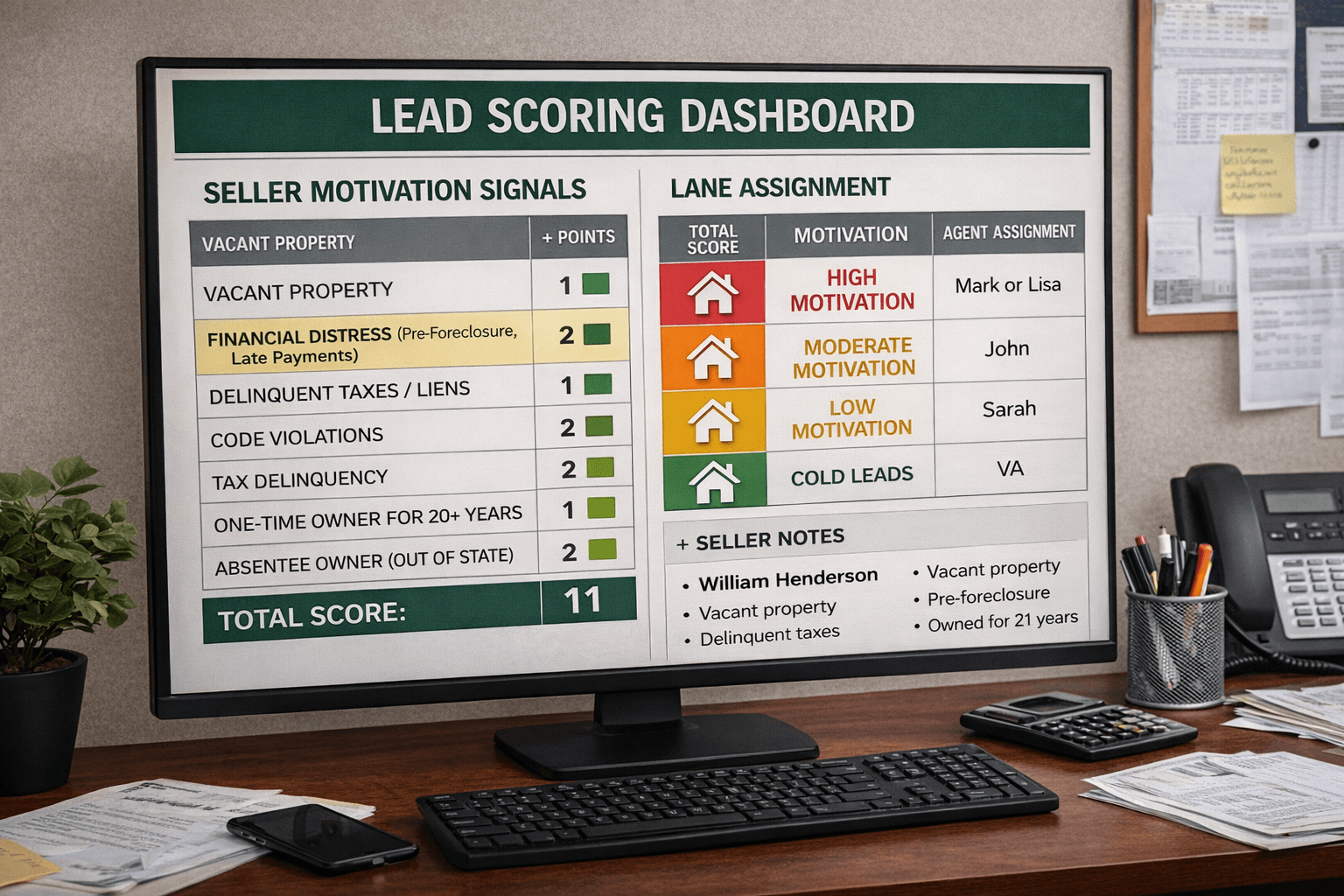
Signal Sensei is the third discipline of The Mantis Method. It's a systematic approach to reading seller motivation, scoring leads objectively, and assigning them to the right lane for follow-up.
The Six Motivation Dimensions
Seller motivation isn't one thing. It's a combination of factors that, when they align, create urgency to sell. We break it down into six dimensions:
| Dimension | What It Measures | High Score Signals |
|---|---|---|
| Ownership Duration | How long they've owned the property | 15+ years, inherited, tired landlord |
| Equity Position | How much room there is for a deal | Free and clear, low mortgage balance |
| Life Events | Personal circumstances creating urgency | Divorce, death, job loss, relocation |
| Property Condition | State of the property itself | Deferred maintenance, code violations, fire damage |
| Market Behavior | How they're acting in the market | Expired listing, price drops, withdrawn MLS |
| Owner Situation | Their current life circumstances | Out of state, elderly, multiple properties |
Each dimension is scored 0-100. The overall motivation score is a weighted average that tells you how likely this seller is to accept an off-market offer.
Reading the Signals
Signals are the specific data points that feed into each dimension. Some are obvious. Others require digging.
High-Value Signals (Worth 8-10 Points)
- Pre-foreclosure notice filed - Urgent financial distress
- Probate filing - Estate needs to liquidate
- Tax lien on property - Financial pressure mounting
- Divorce filing - Need to split assets quickly
- Code violation notice - City pressure to fix or sell
- Owner is deceased - Estate sale likely
Medium-Value Signals (Worth 4-7 Points)
- Expired MLS listing - Couldn't sell traditionally
- Out-of-state owner - Distance creates management burden
- Vacant property - Carrying costs without income
- Multiple price reductions - Motivation increasing
- High equity (70%+) - Room to discount
- Owned 15+ years - Likely tired of property
Lower-Value Signals (Worth 1-3 Points)
- Absentee owner - Not living in property
- Property needs repairs - May want to avoid hassle
- Older owner (65+) - May want to simplify
- Active MLS listing - Already trying to sell
The more signals that stack, the higher the motivation score. A property with pre-foreclosure + tax lien + vacant + out-of-state owner is screaming for attention.
The Lane System
Once you've scored your leads, you need to know what to do with them. The Lane System sorts leads into three categories based on their motivation score and signal density:
| Lane | Criteria | Action | Follow-Up Intensity |
|---|---|---|---|
| Lane A: HOT | Score 80+ OR (Score 60+ with 3+ strong dimensions) | PURSUE | Full 7-Day Strike immediately |
| Lane B: WARM | Score 40-79 with at least 1 strong dimension | NURTURE | Monthly check-ins, watch for changes |
| Lane C: COLD | Score below 40 OR no strong dimensions | ARCHIVE | Quarterly drip, revisit if signals change |
The Lane System prevents two common mistakes:
- Wasting time on cold leads - Stop calling people with no motivation
- Missing hot leads - Make sure your best opportunities get immediate attention
Lane A: The Pursue Protocol
When a lead lands in Lane A, drop everything. These are your money leads.
The Pursue Protocol:
- Same-day contact - Call within 24 hours of identifying
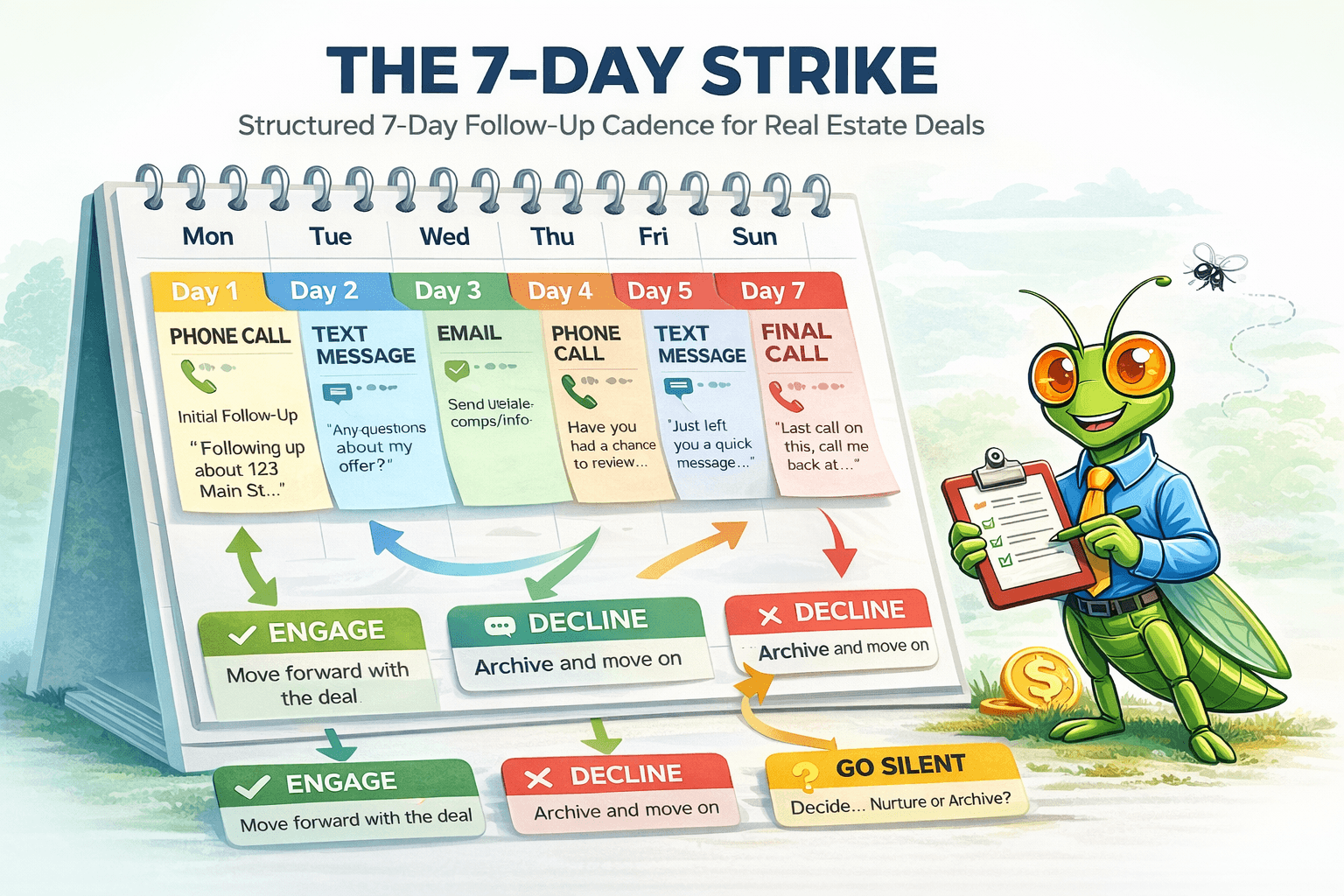
- Full 7-Day Strike - Deploy the complete follow-up cadence
- Appointment push - Try to get face-to-face or at least on video
- Offer ready - Be prepared to submit within 48 hours of conversation
- Priority status - This lead takes precedence over prospecting
Lane A leads don't stay hot forever. Motivation fades. Competitors circle. Act fast.
Lane B: The Nurture Protocol
Lane B leads have potential but aren't ready yet. Your job is to stay top of mind until their motivation increases.
The Nurture Protocol:
- Initial contact - One call and one text to introduce yourself
- Monthly check-ins - Brief touch once a month (text or call)
- Value drops - Occasional market updates or relevant info
- Signal monitoring - Watch for changes that would move them to Lane A
- Patience - These leads convert over months, not days
Many of your best deals will come from Lane B leads that you nurtured for 3-6 months. Don't abandon them.
Lane C: The Archive Protocol
Lane C leads aren't worth active pursuit. But don't delete them entirely.
The Archive Protocol:
- Database storage - Keep their info on file
- Quarterly drip - One touch per quarter maximum
- Re-evaluation - Check for new signals annually
- Reactivation - Move to Lane B if circumstances change
Some Lane C leads will eventually become Lane A. Life happens. Circumstances change. Be there when they do.
The Outreach Angle
Once you know a seller's motivation signals, you can tailor your approach. This is the "angle" - the specific pain point you address in your outreach.
| Primary Signal | Outreach Angle | Example Opening |
|---|---|---|
| Pre-foreclosure | Help them avoid foreclosure damage | "I work with homeowners facing tough situations..." |
| Probate | Simplify estate settlement | "I know dealing with inherited property is overwhelming..." |
| Expired listing | Offer certainty vs. market uncertainty | "I noticed your listing expired. Curious if you'd consider..." |
| Out-of-state | Remove the burden of distance | "Managing a property from out of state is tough..." |
| Vacant | Stop the carrying costs | "Vacant properties are expensive to maintain..." |
| Code violations | Buy as-is, no repairs needed | "I buy properties in any condition..." |
Generic "I want to buy your house" messages get ignored. Signal-specific outreach gets responses.
Common Mistakes
1. Treating All Leads Equal
A pre-foreclosure with code violations is not the same as a random absentee owner. Score them differently. Treat them differently.
2. Ignoring Lane B
Everyone wants Lane A leads. But Lane A is crowded. Lane B leads that you nurture consistently have less competition and convert at similar rates over time.
3. Over-Complicating Scoring
You don't need a PhD to score leads. High signal count + strong distress factors = high score. Keep it simple.
4. Not Updating Scores
Motivation changes. A Lane C lead from six months ago might be Lane A now. Re-evaluate periodically.
How FlipMantis Scores Automatically
FlipMantis uses Signal Sensei scoring on every property in your pipeline:
- Automatic signal detection: Pulls data from public records, MLS, and skip trace
- Real-time scoring: Motivation score updates as new signals appear
- Lane assignment: Automatically sorts leads into Hot, Warm, or Cold
- Outreach suggestions: Recommends the best angle based on primary signals
- Score history: Track how motivation changes over time
No more guessing which leads deserve attention. The system tells you exactly where to focus.
Start Scoring Today
Even without software, you can implement Signal Sensei:
- List your current leads
- For each lead, identify signals from the six dimensions
- Assign a rough score (low/medium/high)
- Sort into Lane A, B, or C
- Apply the appropriate protocol
Do this for your next 10 leads. You'll immediately see which ones deserve your attention and which ones are wasting your time.
Signal Sensei is the third discipline of The Mantis Method. Combined with the 20-5-1 Rule for pipeline activity and the 7-Day Strike for follow-up, you now have a complete operating system for consistent deal flow.
Get The Complete Mantis Method Playbook
Download the free PDF guide with all three disciplines, scoring templates, and the complete system for consistent deal flow.
Available on The Mantis Method page.