Why Most "Free" D4D Apps Aren't Actually Free (And the One That Is)
Drive for Dollars: The Complete Guide to Using a Driving for Dollars App to Find Off-Market Deals
The term "driving for dollars" might sound like a get-rich-quick gimmick, but it's actually one of the most reliable lead generation strategies in real estate investing. The concept is simple: you drive neighborhoods to find potential business opportunities by spotting distressed properties that aren't listed on the MLS. What makes driving for dollars so effective is that you're finding motivated sellers before your competition even knows they exist.
This guide breaks down exactly how driving for dollars works, why many real estate investors swear by it, and how the right driving for dollars app can turn a time-consuming process into a streamlined deal-finding machine. Whether you're new to wholesaling real estate or looking to add another lead source to your business, this strategy deserves your attention.
What Is Drive for Dollars and Why Does It Work?
Drive for dollars is the act of driving through specific neighborhoods looking for properties that show visible signs of distress or neglect. These signs might include overgrown lawns, boarded windows, peeling paint, piled-up mail, or obvious need of repair. The goal is to identify properties where the homeowner might be motivated to sell—often at a discount—because they can't or won't maintain the property themselves.
What makes driving for dollars different from other lead generation methods is the quality of leads you find. When you're driving around a neighbourhood and spot a property that's clearly been neglected, you're seeing real-time data that no online database can replicate. You're not competing with every other real estate investor who pulled the same absentee owner list from PropStream. You're finding off-market properties that haven't hit anyone else's radar yet.
The strategy works because distressed properties often belong to distressed sellers. Maybe it's an inherited property the heirs don't want. Maybe the property owner moved out of state and let the place fall apart. Maybe they're facing financial hardship and can't afford repairs. Whatever the reason, these homeowners are often relieved when someone offers to buy their problem property—even at below market value.
What Are the Benefits of Driving for Dollars?
The benefits of driving for dollars extend far beyond just finding cheap properties. First, you're building a pipeline of off-market deals that your competition doesn't have access to. While other investors fight over the same tired lists, you're sourcing fresh opportunities directly from the street. This is how you find deals that actually have margin built in.
Second, D4D gives you ground-level market intelligence. When you drive neighborhoods consistently, you start to notice patterns—which areas are declining, which are improving, where investors are already active, and where opportunity still exists. This neighbourhood-level knowledge is invaluable for any real estate investor trying to find lucrative markets before they get saturated.
Third, the economics just make sense. Compared to direct mail marketing campaigns that might cost thousands of dollars with a 1-2% response rate, driving for dollars costs you gas money and time. When you combine it with targeted direct mail to only the specific properties you've identified, your marketing dollars go much further. You're not blasting postcards to an entire zip code—you're sending them to properties you've personally verified as distressed.
How Does Driving for Dollars Work Step by Step?
Understanding how driving for dollars works starts with choosing the right neighbourhood to target. You want areas with older housing stock, moderate price points, and signs of deferred maintenance throughout. Avoid brand-new subdivisions and ultra-high-end areas—the sweet spot is usually working-class and middle-class neighbourhoods where homeowners might be struggling to keep up with repairs.
Once you've selected your target area, the process is straightforward. You find yourself driving neighborhoods to find potential business opportunities, looking for properties of interest that show visible distress. When you spot one, you record the address along with notes about what you observed—condition of the roof, state of the yard, whether it appears vacant, and any other relevant property details. The more detailed your notes, the better you can tailor your outreach later.
After your drive, you need to research each property to find the property owner's contact information. This is where you skip trace to get phone numbers and mailing addresses. Then you reach out through your preferred method—some investors send direct mail, others cold call, and many do both. The key is consistent follow-up, because most deals don't happen on the first contact.
What Makes Driving for Dollars Better Than Buying Lists?
Every real estate investor has access to the same purchased lists—absentee owners, pre-foreclosures, high equity, tax delinquent. The problem? So does everyone else. When you buy a list, you're competing with potentially hundreds of other investors who bought the same data. Your direct mail pieces land in a mailbox already stuffed with competitor offers.
What makes driving for dollars superior is exclusivity. When you physically drive a neighbourhood and identify distressed properties yourself, that list belongs to you alone. Nobody else saw that specific house with the caved-in garage and the foreclosure notice on the door. Nobody else knows about the property with three years of newspapers piled on the porch. These are your leads, generated through your effort to find them.
The data is also more current and accurate. Purchased lists are often months old by the time you get them. Properties have sold, owners have moved, situations have changed. But when you drive for dollars, you're capturing new data points in real time. You know exactly what the property looks like today, not what some database says it looked like six months ago. This real-time property data gives you a significant advantage when you reach out to the homeowner.
Can You Drive for Dollars for Commercial Real Estate?
While most investors associate D4D with single-family homes, the strategy works for commercial real estate too. Vacant strip malls, neglected office buildings, and abandoned industrial properties all represent potential opportunities. The signs of distress are similar—deferred maintenance, vacancy, overgrown landscaping, and general neglect.
Commercial drive for dollars requires a slightly different approach. The property owner is more likely to be an LLC or corporation, which can make skip tracing more complex. The deal sizes are larger, which means longer due diligence periods and more sophisticated financing. But the core principle remains: finding off-market real estate opportunities before they hit the broader market gives you a competitive edge.
Many real estate investors start with residential D4D and expand into commercial once they've built capital and experience. The skills transfer directly—you're still looking for distressed properties owned by motivated sellers who might accept below-market offers. The neighbourhood analysis, the property identification, and the outreach process all work the same way.
What Should You Look for When You're Driving?
When you're driving for dollars, train your eye to spot specific indicators of distress or motivation. Overgrown yards and accumulated debris are obvious signs, but look deeper. Check for code violation notices posted on doors. Look for properties that are clearly vacant—no curtains, no furniture visible, mail overflowing. Note properties that appear bank-owned or have auction notices.
Physical condition tells part of the story, but context matters too. A slightly neglected property in an otherwise well-maintained neighbourhood might indicate a homeowner who's overwhelmed or absent. Properties with "for sale by owner" signs that have been up for months suggest a motivated seller who hasn't been able to find a buyer. Estate sale signs or dumpsters in the driveway might indicate a recent death or major life transition.
Also pay attention to properties that are free and clear of obvious distress but show subtle signs of vacancy or transition. Not every deal comes from a boarded-up eyesore. Sometimes the best opportunities are properties where the owner simply wants out—maybe they inherited it, maybe they're relocating, maybe they're tired of being a landlord. These homeowners are often easier to work with and the properties require less rehab.
How Does a Driving for Dollars App Eliminate the Busywork?
The traditional D4D process involves a lot of manual work. You drive around scribbling addresses on paper, come home and manually research each property, type everything into an excel spread sheet, then figure out how to send them mail or make calls. It's effective but tedious, and many investors burn out before they see results.
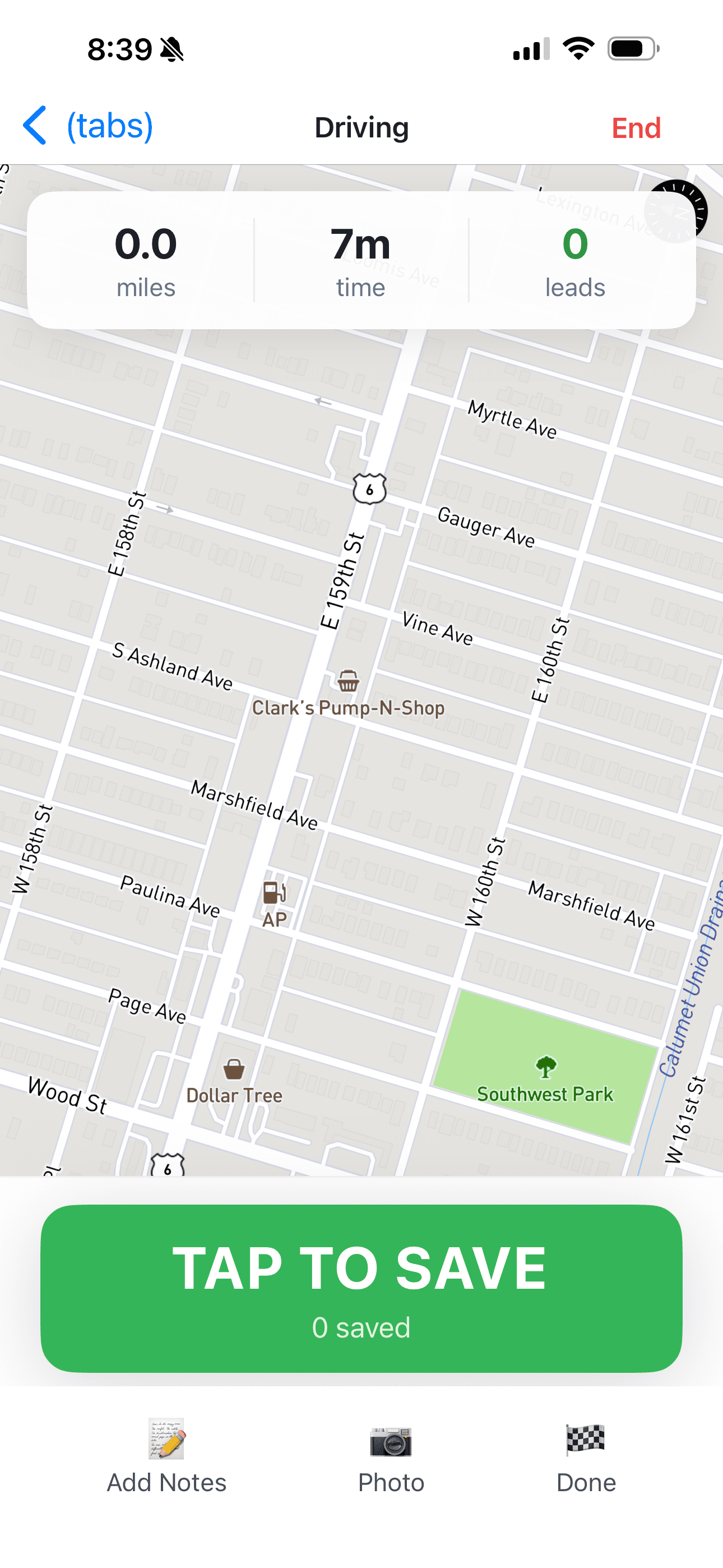
A modern D4D app eliminates all the work that used to make this strategy so time-consuming. Instead of pen and paper, you drop pins on specific properties directly in the app while you drive. The app will eliminate the need to manually research owners because it pulls property details and owner information automatically. Your D4D app is integrated with skip tracing, so you get phone numbers and mailing addresses without switching between platforms.
The efficiency gains are substantial. What used to take hours of researching and driving now happens in real time. The app tracks your routes so you don't accidentally drive the same streets twice. It exports your lists in formats ready for outreach, and some apps even let you easily mail merge and send direct mail marketing campaigns without leaving the platform. This is what a proper driving for dollars app should do—remove friction so you can focus on finding deals.
Should You Hire Someone to Drive for Dollars?
As your business grows, you might consider having an employee do this work instead of doing it yourself. This is called "bird-dogging," and it can scale your D4D efforts significantly. You train someone to recognize distressed properties, give them a territory, and pay them per lead or per hour. Some investors pay $10-25 per verified lead.
The advantage is obvious: you can cover more ground without spending your own time behind the wheel. While your bird-dogger drives one neighbourhood, you can be analyzing deals, negotiating with sellers, or working on other aspects of your businesses success and you find yourself with more time for high-value activities. The app eliminates all the work of coordinating with multiple drivers too—everyone logs leads in the same system.
The downside is quality control. Nobody will care about your business as much as you do, and some bird-doggers will log junk leads just to hit their numbers. You need clear criteria, regular ride-alongs to calibrate, and a system to verify lead quality. But when it works, having someone else drive for dollars while you focus on closing deals is a powerful way to scale.
How Do You Contact Property Owners After Finding Their Properties?
Once you've identified properties you find promising, the next step is reaching out to the property owner. Most investors use a multi-channel approach: direct mail first to establish credibility, followed by phone calls for immediate response, and sometimes door knocking for the most promising leads. The key is persistence—most sellers won't respond to your first attempt.
For direct mail, send something that stands out from the typical "we buy houses" postcards that flood motivated seller mailboxes. Reference the specific property and what you observed. "I noticed your property at 123 Main Street appears to be vacant and thought you might be interested in selling" is more effective than generic "I buy houses in any condition" messaging. Personalization shows you're serious and did your homework.
Phone outreach requires finesse. You're calling someone who didn't ask to be contacted, so lead with empathy and value. Ask questions about their situation rather than launching into a pitch. Many homeowners dealing with distressed properties are embarrassed or overwhelmed—your job is to position yourself as a solution to their problem, not another source of stress. Find motivated sellers by understanding what's motivating them specifically.
Why Is FlipMantis the Best Driving for Dollars App for Investors?
Here's where most driving for dollars guides get vague, but we'll be direct: if you're serious about D4D, you need a tool built specifically for real estate investors, not a generic app with D4D bolted on as an afterthought. FlipMantis was built by an investor who got tired of paying for five different subscriptions just to run a wholesaling operation.
The FlipMantis D4D feature is genuinely free—not a 7-day trial, not a feature-limited teaser. You can drive neighborhoods, pin properties, access property data, and manage leads without paying a subscription. The property details screen gives you owner information, property history, and everything you need to start outreach. When you find potential deals, they flow directly into the CRM for follow-up.
What makes FlipMantis different is integration. Driving for dollars is one piece of the real estate market puzzle—you also need deal analysis, CRM, dialer, and marketing tools. Other apps force you to pay for D4D separately, then pay again for a CRM, then pay again for skip tracing. FlipMantis consolidates everything so you can find off-market deals and actually close them without juggling multiple platforms. For any real estate investor serious about finding off-market properties, it's the obvious choice.
Key Takeaways: What You Need to Remember About Drive for Dollars
- Drive for dollars is a proven lead generation strategy where you physically drive neighborhoods looking for distressed properties with motivated sellers
- The main advantage is exclusivity—unlike purchased lists, the leads you find through D4D aren't being marketed to by every other investor
- Look for visible signs of distress including overgrown yards, deferred maintenance, vacancy indicators, and code violations
- A driving for dollars app dramatically increases efficiency by eliminating manual research, tracking routes, and integrating with outreach tools
- Multi-channel follow-up is essential—combine direct mail, phone calls, and persistence to convert D4D leads into deals
- Consider scaling with bird-doggers once you've refined your process and want to cover more ground
- FlipMantis offers truly free D4D functionality integrated with CRM, deal analysis, and marketing tools—no subscription required to start
- Consistency beats intensity—regular driving in targeted neighbourhoods will produce better results than occasional marathon sessions